December 2025 delivered one of those declarations that typically belong to conspiracy theory territory, except this time it emanated directly from someone with every interest in maintaining silence: Dame Hannah Rothschild, seventh-generation scion of the banking dynasties that have dictated unwritten financial rules for over two centuries, confirmed in a CNBC interview what uncomfortable historians have always maintained and respectable thinkers have always vehemently denied—that no government or monarch has ever dared declare war without the support and approval of her family, because without the capital flowing through their international banking networks, war machines halt before they even start.
The admission arrives with that irritating naturalness belonging only to those who know themselves untouchable, to those who can afford to tell the truth because nothing will change anyway, because the system is so deeply rooted, so stratified across centuries of financial control that even revealing it openly doesn’t scratch the power structure sustaining it—rather, it confirms its inevitability.
From Frankfurt Ghetto to Global Power: The Rise of Banking Dynasties
Hannah Rothschild, during the recording of “CNBC Meets: Legacies” at a private banking event organized by United Overseas Bank in Singapore, explained with didactic tone how her ancestor Mayer Amschel Rothschild founded the empire in the 1760s in Frankfurt, strategically dispatching his five sons—Amschel, Salomon, Nathan, Carl, and James—to major European capitals: Frankfurt, Vienna, London, Naples, and Paris, creating what she herself defines without embarrassment as “the world’s first truly international banking network,” a financial architecture that allowed the family to dominate cross-border finance and position themselves as indispensable intermediaries between sovereigns needing funds for their wars and the wars themselves that, without those funds, simply could not be fought.
As we documented in our previous article on the world’s most powerful families, modern history cannot be understood without knowing the genealogy and movements of these banking dynasties that shift from one part of the globe to another to dominate it financially in its entirety, having grasped that this is the essential condition for directing it politically as well, hiding behind the appearances of politicians whether kings or republican presidents, because money primarily aims at power, exactly as avarice depends on pride and relates to it.
Carrier Pigeons and Capital: Communication Networks of Banking Dynasties
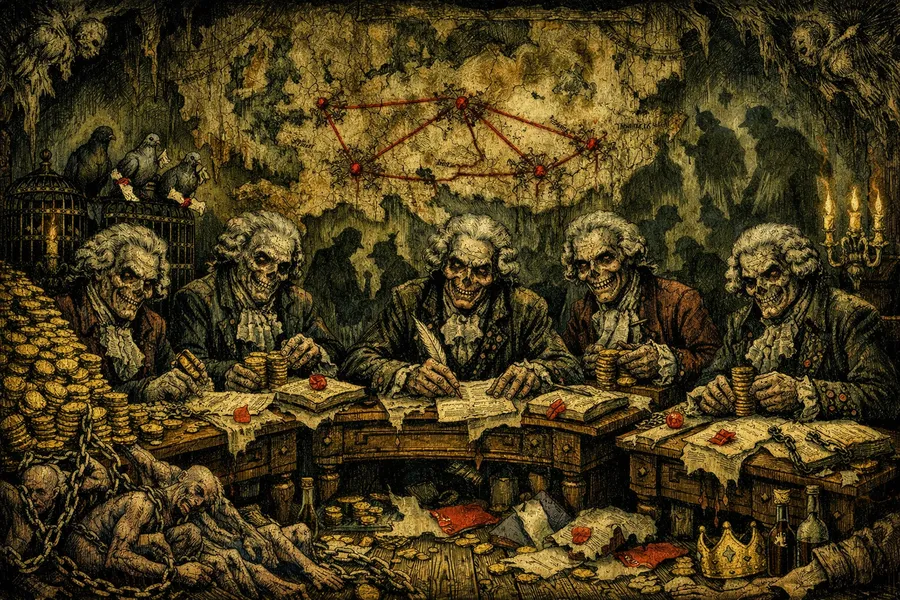
The family’s guiding principle, Hannah emphasized with pride, was “togetherness”—a word that sounds reassuring and familiar when it actually describes a perfectly orchestrated financial cartel, where constant communication among the five branches, facilitated even by carrier pigeons for brief critical messages alongside trusted couriers, guaranteed a decisive advantage in an era when postal systems were slow and unreliable, allowing the Rothschilds to know before everyone else, move before everyone else, control information worth more than the gold they lent.
Hannah specifically emphasized the five brothers’ use of carrier pigeons to relay brief critical messages swiftly, a method complementing their trusted couriers and giving them a decisive edge in an era of slow postal systems—but beyond the picturesque anecdote, what matters is substance: information control, capital circulation speed, the capacity to always be one step ahead of governments that believed they commanded while actually depending completely on Rothschild loans.
Banking Dynasties’ Role in Napoleonic Wars and the Architecture of Perpetual Debt
The Rothschilds’ control over financing has been historically linked to crucial events, including loans supporting governments during the Napoleonic Wars and beyond: historical accounts show Nathan Mayer Rothschild in London played a central role in funding British efforts against Napoleon through bullion transfers and subsidies to allies—operations requiring the family’s tacit approval for any large-scale conflict to proceed without financial collapse, effectively transforming the Rothschilds from mere bankers into invisible arbiters of European history, those who decided which nations could afford to fight and which could not.
As father Mayer Amschel taught his five sons, one shouldn’t limit oneself to lending money only to simple rich people or even nobles, but aim higher and “give” to kings as well, who constantly needed money for their wars, and furthermore he explained that to avoid the danger of not being compensated by kings, they must immediately obtain, in exchange for their gold, the guarantee of managing tax levies on the kings’ subjects themselves, so that in practice the debt could pass from sovereign to people, overwhelmed without even imagining being indebted to a usurer rather than their own king.
The Debt Multiplication Strategy
The strategy was crystalline in its perversion: if the debtor were rendered unable to pay his debt, it would become infinite—thus they managed to circulate such a low amount of gold that it didn’t allow debtors enough to settle their debt completely, leading to infinite debt multiplication so that Europe’s peoples became forever indebted to banks and especially to the Rothschilds.
Modern Banking Dynasties: RIT Capital and Contemporary Control
The Rothschild legacy continues today through their institutions—RIT Capital Partners, Windmill Hill Asset Management, Five Arrows, alongside the philanthropic Rothschild and Yad Hanadiv foundations—but Dame Hannah’s admission reminds the world that behind the polished facade of wealth and duty lies the capacity to decide whether nations rise or fall in battle, a power no democratic election ever granted, no parliament ever ratified, no people ever chose, yet it exists, functions, determines history’s course while everyone continues believing governments decide when to go to war, when actually bankers decide it long before the first tanks move toward the front.
Hannah also mentioned maintaining 10% of her personal portfolio in gold and 1% in cryptocurrencies, candidly admitting: “I don’t really understand crypto… I still think there’s an Emperor’s New Clothes aspect of it”—a statement reeking of involuntary irony when coming from someone whose family literally invented the concept of money as abstraction, as symbol of real wealth that can be manipulated, multiplied, lent at infinite interest until creating debt empires subjugating entire nations.
Hannah Rothschild’s Admission: Banking Dynasties Speak Openly
The Rothschild name, Hannah said with frankness tasting of confession and challenge simultaneously, “walks into the room before you do—it comes with enormous history, quite a lot of gravitas, quite a lot of conspiracy theories, and quite a lot of responsibility”—and in this admission lies all the arrogance of those who know they can afford to tell the truth because the system is too big to be scratched, too rooted to be toppled, too essential to modern capitalism’s very functioning to be seriously questioned.
Conspiracy theories—those respectable journalists deride with sufficiency in culture’s mainstream salons—reveal themselves once again less conspiratorial than one wants to admit, because when the dynasty’s own protagonist confirms that without their support no government has dared wage war in the last two centuries, then perhaps it’s time to reconsider who truly are the puppeteers and who the puppets in this horror theater we call modern history.
Who Really Governs? Banking Dynasties vs. Democratic Institutions
The question nobody dares formulate openly is simple and terrifying: if the Rothschilds and other banking dynasties documented in our previous article—the Warburgs, Rockefellers, Elkanns, Lazards—have power to authorize or deny wars, then who really governs? Elected presidents or unelected bankers? Parliaments or investment bank boardrooms? The sovereign people or sovereign capital?
The answer is obvious as it is uncomfortable, which is why it’s systematically omitted from history books, removed from geopolitical analyses, derided as conspiracism whenever someone dares raise it, because admitting real power resides not in democratically elected governments but in hereditary banking dynasties would mean admitting democracy itself is little more than performance, a show to entertain masses while real decisions get made elsewhere, in rooms where people never enter, in meetings where votes don’t count and only capital matters.
The Privilege of Hereditary Financial Power
Hannah Rothschild is 63, sits on boards of various family entities, presides over philanthropic foundations operating in art, culture, education in Israel, writes satirical novels about aristocratic and financial elites she herself perfectly embodies—and when her father Jacob died in early 2024 she candidly admitted receiving no clear succession instructions: “When he died, there were some revelations, there was no clear ‘this is exactly what I expect of you’—I’ve had to make up a lot of what I’m doing as I’ve gone along”—a confession revealing how even within these dynasties power gets transmitted more by osmosis than decree, more by blood belonging than meritocratic competence.
The CNBC interview shows Hannah Rothschild relaxed, self-assured, conscious of the surname’s weight she carries while simultaneously proud of having earned her position “both inside and outside the family” through hard work—a narrative sounding almost comic when considering the starting point was being born firstborn daughter of the fourth Baron Rothschild, with a network of contacts including prime ministers, central bankers, industry magnates and world-famous artists, raised listening to conversations about Japanese economy at age nine during dinners with Rudolf Nureyev, Lucian Freud, and Isaiah Berlin.
Privilege never had a kinder face nor more disarming confession, because Hannah openly acknowledges it was “an incredible gift and an accident to be born with this privilege,” immediately adding “it is our responsibility to make the most of it”—thus transforming inherited fortune into moral obligation, dynastic power into philanthropic duty, financial omnipotence into cultural responsibility, a narrative serving perfectly to legitimize what otherwise would be recognized for what it is: a financial aristocracy perpetuating itself through generations without ever submitting to democratic judgment of the people it indirectly governs.
The Interweaving of Banking Dynasties: Marriage, Alliance, and Control
Truth, as always, is simpler and more brutal than rhetorical elaborations masking it: there exists a financial elite that for over two centuries has determined which nations can afford to wage war and which cannot, which regime can survive and which must fall, which economy can prosper and which must collapse—and this elite operates through family networks interweaving through strategic marriages, commercial alliances, cross-participations, exactly as we documented in our previous article where we explained how the intersection of Hahn-Elkann, Worms, and Rothschild families created a financial control network extending from Europe to America to the Middle East.
When in 1975 the Elkanns intermarried with the Agnellis through Alain Elkann’s marriage to Margherita Agnelli, it wasn’t a simple marriage but fusion of two financial empires, with John Elkann today presiding over FIAT while maintaining close family banking ties, demonstrating once again how these dynasties operate through long-term strategies embracing generations and crossing national borders as if they didn’t exist.
The Waterloo Profit Model: How Banking Dynasties Win Every War
Hannah Rothschild’s CNBC admission is significant precisely because it arrives at a historical moment when global financial elites seem to have reached such a power consolidation level that they feel sufficiently secure to openly admit what was previously vehemently denied: that contemporary financial capitalism isn’t a free market system but an oligarchic structure controlled by few families operating coordinately to maintain and expand their dominance.
The phrase that should make one reflect, the one that should be printed and hung in every contemporary history classroom, is Hannah’s own: no government or king has dared go to war without Rothschild support—which means every conflict of the last two centuries, every world war, every externally funded revolution, every “humanitarian” military intervention required prior approval not from democratically elected parliaments but from banking dynasties controlling capital flows without which modern war machines simply cannot function.
Waterloo, as we recalled in our previous article, wasn’t won by Wellington on the battlefield but by English Rothschilds who financed the British campaign, while French Rothschilds then lent funds to defeated France to compensate England for war expenses—a perfect game where victors and vanquished both end up indebted to the same family of bankers who financed both conflict sides, guaranteeing profits independent of military outcome.
This is power’s true face in the contemporary world: not generals moving armies, not politicians signing treaties, but bankers deciding whom to lend money for fighting and under what conditions, rendering every war not a conflict between nations but a commercial transaction where peoples massacre each other reciprocally while Rothschilds and other financial dynasties count profits on both sides.
Banking Cremation and the Subversion of Democratic Power
Banking cremation, as we’ve defined it, has subverted healthy economy by transforming money from auxiliary instrument for purchasing necessary goods into humanity’s ultimate end, and from this financial disorder to social revolution the step was brief, with currency instability, job precariousness, constant unemployment, growing inflation being ultimate consequences of this system that made symbolic wealth represented by money man’s and states’ final objective, sliding increasingly toward chaos and anarchy.
Hannah Rothschild will continue presiding over her foundations, writing her satirical novels about declining aristocracy, sitting on family financial entities’ boards—and the world will continue turning as if nothing changed, as if this admission hadn’t just torn the veil on two centuries of institutional lies, because by now the system is so rooted, so essential to global capitalism’s very functioning, that even openly revealing its mechanisms no longer produces any effect, no revolt, no change.
Peoples will continue voting for politicians having no real power, debating electoral programs never to be implemented, believing they live in democracies when actually inhabiting masked plutocracies—and banking dynasties will continue pulling strings from behind scenes, deciding which wars can be fought and which cannot, which economies can prosper and which must be plundered, which nations can survive and which must collapse.
The only thing truly surprising in this entire affair is our infinite capacity to pretend nothing important is happening, to continue living as if the world were governed by presidents and prime ministers instead of hereditary bankers, to insist on calling “conspiracy theory” what is now public confession by those exercising real power.
But perhaps this is precisely their success secret: not hiding power but making it so blatant, so undeniable, that minds refuse to accept it for pure self-defense, because admitting we live in a system where few families decide billions of people’s destiny without ever being elected would mean completely rethinking every assumption upon which we’ve built our understanding of the modern world.
This is why Hannah Rothschild’s interview is simultaneously confession and supreme arrogance act: confessing the crime when knowing there will be no consequences is absolute power’s purest form, ultimate exercise of power no longer needing to hide because it knows itself untouchable.
Sources
1. The Rothschild Archive (Official Family Archive) https://www.rothschildarchive.org/business/n_m_rothschild_and_sons_london/nathan_mayer_rothschild_and_the_waterloo_commission
Documenta il ruolo di Nathan Rothschild nel finanziare Wellington durante le guerre napoleoniche, la rete di corrieri e agenti, e conferma la citazione “The best business I ever did” riguardo Waterloo.
2. Stanford University Press – “Nathan Mayer Rothschild and the Creation of a Dynasty” https://www.sup.org/books/history/nathan-mayer-rothschild-and-creation-dynasty
Studio accademico basato su archivi finanziari che analizza transazione per transazione come Rothschild divenne “Britain’s banker and paymaster on the Continent”, consolidando la dinastia finanziaria.
3. Cambridge University Press – “The Cambridge History of the Napoleonic Wars” https://www.cambridge.org/core/books/abs/cambridge-history-of-the-napoleonic-wars/funding-war-2-britain/A0B522831EE2EADD5A102C561628B00F
Conferma che per gli ultimi due anni di guerra “the government had to deploy the talent and energy of Nathan Meyer Rothschild to ensure that the British army on the continent was paid.”
4. Age of Revolution (Museum Exhibition Source) https://ageofrevolution.org/200-object/coins-that-paid-for-the-battle-of-waterloo/
Documenta fisicamente le monete d’oro e argento da tutto il mondo raccolte dai Rothschild, con la scritta originale sul cofanetto che identifica “bullion specie furnished by Mr. N. M. Rothschild to J. C. Herries Esq., Commissary in Chief” April-October 1815.
5. Business History Journal – “Family banking in an era of crisis: N.M. Rothschild & Sons” https://www.tandfonline.com/doi/abs/10.1080/00076791.2012.744586