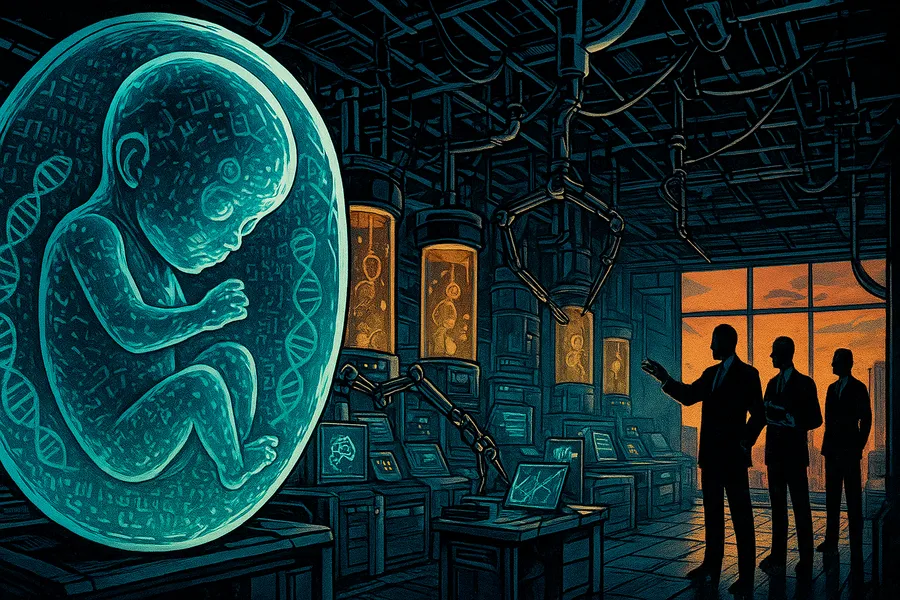
There is no need to wait for a dystopian future, because that future is already operational in Californian laboratories where billionaires with more money than sense of restraint have decided that human reproduction requires an upgrade, an optimisation, the same market logic they apply to their technology startups—with the non-trivial difference that this time the object of optimisation is not an algorithm but the living flesh of our children, and that the bugs to be eliminated are the imperfections that have always made humanity vulnerable, fragile, and precisely for this reason human.
The news emerges from American laboratories with the slowness characteristic of revelations no one truly wishes to confront: startups funded by figures such as Sam Altman (CEO of OpenAI), Brian Armstrong (founder of Coinbase), and Peter Thiel are actively financing projects for the selection and genetic modification of human embryos, despite such practice remaining prohibited in most countries worldwide, including the United States when it comes to germline genetic editing—that modification which transmits to future generations and transforms every experiment into an experiment upon the entire species.
The Market for Genetic Perfection
Heliospect Genomics represents the commercial vanguard of this new eugenicism dressed as scientific progress, and its tariffs already tell us everything we need to know about the nature of this project: up to fifty thousand dollars for screening one hundred embryos, with the explicit promise of selecting those with the highest intelligence potential, thus predisposing a future where a child’s IQ is negotiated before that child even exists, where parents can scroll through embryos as though they were profiles on a dating app, choosing not only sex but also predicted height, obesity risk, predisposition to mental illness, and—naturally—what company employees candidly call “IQ and the other naughty traits everyone wants,” as if eugenic selection were a matter of harmless aesthetic preferences, a whim to indulge for those who can afford it.
CEO Michael Christensen, a former financial markets trader who moved into genetics with that nonchalance characteristic of those who never question their right to do whatever the market permits, described his vision during a recorded video call in November 2023: “Everyone can have all the children they want, and they can have children that are basically disease-free, smart, healthy; it’s going to be great.” The simplicity of the formulation betrays the enormity of the ambition: we are discussing deciding which lives deserve to be lived and which should instead be discarded under the microscope, a practice we called eugenics until yesterday but which today, cloaked in Silicon Valley corporate language, becomes “reproductive optimisation.”
The Technology of Biological Control
The technical process hides behind reassuring acronyms: PGT-P (Preimplantation Genetic Testing for Polygenic disorders), a methodology that analyses hundreds or thousands of genetic variants to produce “polygenic risk scores”—statistical predictions of the probability that an embryo will develop certain characteristics once born. Unlike traditional genetic screening, which identifies monogenic diseases such as cystic fibrosis (conditions caused by a single defective gene and therefore relatively easy to identify), PGT-P ventures into the far more slippery territory of polygenic traits: intelligence, height, predisposition to depression, all phenomena determined by the complex interaction of thousands of genes and environment, rendering any prediction statistically fragile and scientifically controversial.
The startups involved—besides Heliospect, also Orchid Health (founded by Noor Siddiqui, a former Thiel Foundation fellow), Nucleus Genomics, Herasight, and others still—utilise public genetic databases such as the UK Biobank, a British archive containing genetic, medical, and social information from half a million volunteers who consented to the use of their data “for health research in the public interest.” None of those volunteers probably imagined that their data would be employed to develop commercial embryo selection services destined for the American elite, creating an ethical paradox where British citizens unwittingly provide the genetic material for a practice that is illegal in the United Kingdom.
Preventive: Genetic Editing as Humanitarian Mission
The subsequent escalation was inevitable, because selecting existing embryos could not suffice for those who have internalised the “move fast and break things” logic typical of Silicon Valley—and what exactly breaks when you apply this philosophy to human reproduction? You break babies, as Hank Greely, a Stanford bioethicist, observed, with that lucidity which ought to be self-evident but sounds almost revolutionary in a context where the only recognised metric is profit and innovation at any cost.
Preventive, founded by scientist Lucas Harrington and funded with thirty million dollars by investors including Sam Altman and Brian Armstrong, presents itself as a “public-benefit company” dedicated to researching how to “create genetically modified babies safely and responsibly.” The project’s previous name — Manhattan Genomics — reveals far more than the company would wish to admit: the reference to the Manhattan Project, the programme that developed the atomic bomb, is deliberate and proud, because for these entrepreneurs the genetic manipulation of our species represents a technical challenge of the same historical magnitude, without apparently asking whether that historical magnitude is a reason to proceed or to stop.
Germline genetic editing—modifying embryonic DNA so that changes transmit to future generations—remains technically illegal in the United States and the majority of countries with regulations on the matter. The last public attempt dates to 2018, when Chinese scientist He Jiankui announced the birth of the first genetically modified twins using CRISPR, provoking horror in the international scientific community and being imprisoned for three years by the Chinese government. That precedent was meant to serve as a deterrent; instead, for Silicon Valley entrepreneurs, it simply highlighted an as-yet unexploited market opportunity.
Brian Armstrong, the cryptocurrency billionaire behind Coinbase, allegedly discussed with colleagues the idea of secretly revealing the birth of a healthy genetically modified baby as a strategy to force public acceptance of the practice—a marketing move that treats the birth of a modified human being as the launch of a technological product, where what matters is not informed societal consent but the fait accompli that precedes and determines debate.
Pronatalism and the Obsession with Quantity
The narrative sustaining this movement sinks its roots into Silicon Valley pronatalism, that ideological current which views demographic decline as an existential threat to the human species and sees reproductive technology as the solution. Figures such as Malcolm and Simone Collins, an influential couple in the pronatalist movement, already use embryo selection for their own children and openly promote the adoption of artificial wombs, laboratory-created embryos, and genetic editing as necessary tools to increase birthrates, transforming reproduction into an optimised industrial process where what matters is the quantity of births and the genetic quality of those born, as though we were discussing automobile production rather than the coming into the world of persons.
The Collinses describe the use of genetic technology as “low-effort parenting,” unwittingly revealing the horror underlying their vision: children become projects to optimise at the design stage to reduce future maintenance costs, a managerial logic applied to flesh and blood, where every genetic imperfection eliminated in advance represents a saving of time, money, and worry, never asking what it means for a human being to know they were selected as the best model among one hundred discarded alternatives.
Liberal Eugenics and Its Philosophers
Intellectual support for this drift comes from figures such as Jonathan Anomaly, a philosopher and former lecturer at Duke and Penn, now senior staff member at Heliospect Genomics, author of essays bearing titles like “Defending Eugenics” and “Creating Future People,” where he argues that eugenics has become a “dirty word” unjustly because of the Nazi euthanasia programme and forced sterilisations in twentieth-century America. His proposal for “liberal eugenics”—where reproductive decisions remain with parents without state intervention—sounds reassuring only until one considers that any form of eugenics, even voluntary, inevitably creates social pressures and expectations that transform “choice” into implicit obligation for those who wish to compete in a society where genetic optimisation becomes the standard.
Research conducted by investigative organisations such as Hope Not Hate has revealed that several staff members at Heliospect and similar companies have connections with publications and figures associated with “scientific racism”—that current which maintains the existence of innate intellectual and moral differences between human races determined genetically. Anomaly and others have denied these accusations, stating that their works do not discuss race and that IQ does not represent an indication of moral worth, but the very presence of these figures in key positions within genetic selection companies raises inevitable questions about the movement’s ideological direction.
The Fragile Science Behind the Promises
The most devastating scientific critique of these technologies comes from the genetic community itself. The American College of Medical Genetics and Genomics has not approved the clinical use of PGT-P, whilst the British regulatory authority Human Fertilisation and Embryology Authority has declared that PGT-P “does not meet the criteria for genetic testing and is currently not backed by evidence from scientific studies.” A study published in Nature in 2023 concluded that these services are “not sufficiently effective or robust for embryo selection.”
The fundamental problem is that complex polygenic traits such as intelligence do not function like genetic switches to activate or deactivate. Sasha Gusev, who directs a quantitative genetics laboratory at the Dana-Farber Cancer Institute, explains that numerous confounding socioeconomic factors—childhood nutrition, geography, social networks, parenting styles—render it practically impossible to trace outcomes such as educational attainment to genetics in a reliable manner. And he adds: “There’s a real risk in moving toward a society where you see genetics and ‘genetic endowments’ as drivers of people’s behaviour and as a ceiling on their capabilities.”
A further paradox emerges from the genome’s very structure: the parts of DNA that influence one complex trait inevitably influence other traits as well. Selecting an embryo with higher probability of elevated educational attainment also means selecting an embryo with sixteen per cent higher relative risk of developing bipolar disorder, according to a study published in the New England Journal of Medicine. Research shows significant overlaps between genetic variants associated with autism and those linked to psychiatric conditions, rendering it impossible to “choose” a desirable trait without bringing along unpredictable genetic consequences.
The Already Born Children: The First Victims
The first human beings conceived through PGT-P genetic selection are now adolescents, and emerging testimonies confirm the worst scenarios predicted by critics. Some of these young people, as reported by researcher Brigitta van Beers of the Vrije Universiteit Amsterdam, “struggle with identity issues” because they know their parents selected them based on specific genetic traits, and they feel pressure to correspond to that “purchased profile.” There are documented cases where parents have openly expressed disappointment when their child did not meet their genetic expectations, a form of psychological violence made possible by the commodification of human existence, where a child becomes a defective product if they do not match the specifications promised by the vendor.
The Computational Vision of Reproduction
The paradigm sustaining this entire system is what van Beers calls the “computational vision of reproduction”: in Silicon Valley, genetic code is increasingly considered like computer code, something that can contain bugs and therefore be corrected, optimised, updated. Eric Schmidt, former Google CEO, recently predicted that biotechnology is about to have its “ChatGPT moment,” suggesting massive acceleration in genetic modification with the risk that ethics and legislation remain dramatically behind technology.
This mentality transforms reproduction from a biological and relational event to a rational production process driven by data. Commercial platforms openly advertise with slogans such as “Choose your healthiest embryo” or “Choice over chance,” showing prospective parents scores for their embryos which they can select based on perceived genetic “quality,” like school report cards—but for embryos. Spanish entrepreneur Martín Varsavsky, active in this sector, says it bluntly: “Sex is great, but it is not the best way to make a baby,” arguing that reproduction needs to be “professionalised.”
The Political Context: Deregulation and Opportunism
The rise of this genetic market is not accidental but facilitated by a specific political context. The Trump administration, with its deregulatory stance and declared support for reproductive technologies such as in vitro fertilisation, creates according to some observers the perfect conditions for loosening existing prohibitions. American regulation on embryology is virtually non-existent, transforming the United States into what some experts call an “embryology wild west” where any practice not explicitly prohibited automatically becomes permitted.
The startups involved are deliberately navigating regulatory grey zones, concentrating on screening rather than direct editing (which remains prohibited) but constantly pushing the boundaries of what is acceptable. Cathy Tie, a biotech entrepreneur and founder of Manhattan Genomics (now renamed Preventive), ex-wife of He Jiankui—the Chinese scientist imprisoned for creating the first genetically modified babies—declares that “the timing is right for having this conversation” about germline genetic editing, interpreting the political climate as a market opportunity.
The Class Implications: Eugenics for the Wealthy
The prohibitive cost of these technologies—tens of thousands of dollars for screening alone, not to mention the costs of in vitro fertilisation necessary to generate embryos to select—guarantees that access remains limited to a narrow economic elite. Katie Hasson, associate director of the Centre for Genetics and Society in California, warns that embryo selection technology risks “mainstreaming the belief that inequality comes from biology rather than social causes,” naturalising class differences as genetic differences and creating a new biological aristocracy where the children of the elite are born literally with genetic advantages that the children of lower classes cannot afford.
Fyodor Urnov, director of the Innovative Genomics Institute at UC Berkeley, uses even harsher words: people “armed with very poorly deployed sacks of cash” are effectively pursuing “baby improvement,” a formulation that reveals the intrinsic absurdity of the project—as though babies were software to upgrade rather than human beings to welcome in their constitutive imperfection.
The Failure of Ethical Consensus
The speed with which these technologies are being commercialised is destroying what was a fragile but existing ethical consensus: the idea that playing God with the human genome is something dangerous, with probable serious unintended consequences. The startups involved, as an American Enterprise Institute analysis observes, “are not building anything” in the innovative sense of the term—they are simply applying existing technologies (IVF and genetic sequencing) to a new market, lying to their customers by promising predictive powers they do not yet possess.
A survey conducted in 2024 by Harvard Medical School revealed that, whilst three-quarters of Americans support using emerging technology to screen embryos during IVF for health conditions, only one-third approve using the technology to predict traits unrelated to disease. Almost all respondents expressed concerns about potential negative outcomes for individuals or society. But in the unregulated world of reproductive technology, public consensus is irrelevant: everything not explicitly prohibited automatically becomes marketable.
The Pretence of Scientific Moratorium
Scientific organisations such as the International Society for Cell and Gene Therapy (ISCT) called in May 2025 for a ten-year moratorium on the use of CRISPR and related technologies for human germline editing, emphasising that any attempt to create genetically modified babies should remain strictly prohibited. But these declarations sound increasingly like pious intentions in the face of the amount of private capital flowing into the sector: Preventive has raised thirty million dollars, Bootstrap Bio is seeking seed funding with explicit interest in “intelligence enhancement,” and other startups continue to emerge monthly.
The mainstream scientific community remains largely sceptical or hostile, with several research groups having refused collaborations with these companies. Urnov declared he had “harsh words” for Manhattan Genomics when the company contacted him about collaboration. But scientific isolation does not stop entrepreneurs convinced that safety is merely a technical issue to resolve and that regulation is a temporary obstacle to circumvent.
The Inevitable Escalation
Market logic, once triggered, follows a predictable trajectory. Christensen has already openly discussed the possibility of creating “lab-grown eggs” that would allow couples to generate embryos on an industrial scale—a thousand, even a million—from which to manually select the elite. He suggested that future technologies might permit screening for “dark triad traits”—Machiavellianism, narcissism, and psychopathy—as though human personality were a menu from which to order preferred options.
Anomaly, in his book “Creating Future People,” argues that adoption of these technologies is “inevitable”: sooner or later more elites will openly use the technology, and a preference cascade will cause people to shift from reluctance and condemnation to support for embryo selection, and eventually gene editing. For him the question is not whether we use the technology, but how we use it and how we decide what kinds of people we want to bring into the world—a formulation that already presupposes as inevitable what should instead remain subject to collective choice.
The End of Acceptance
What is happening in Californian laboratories funded by technology billionaires is not progress but the transformation of human reproduction into a market where children become customisable products, where genetic imperfection is treated as a manufacturing defect to eliminate, where the fundamental biological equality of the species—that condition whereby we are all born equally vulnerable, equally imperfect, equally dependent upon others’ care—is replaced by a genetic hierarchy encoded in DNA before birth itself.
The long-term consequences are difficult to predict completely, but some effects are already visible: children growing up knowing they were selected as the superior model among discarded alternatives, parents expressing disappointment when children do not match purchased genetic specifications, a society increasingly internalising the idea that human worth derives from optimised biological endowments rather than that intrinsic dignity we recognised in every person regardless of their characteristics.
The rhetoric of “improvement” and “disease prevention” barely conceals what this project truly represents: an experiment upon the species conducted by a minuscule economic elite which has decided unilaterally to rewrite the fundamental terms of human existence, without consulting anyone, without seeking society’s consent, armed only with the certainty typical of those who have always had enough money to confuse their personal will with humanity’s progress.
And perhaps the most disturbing thing is not even the technology itself, which remains a neutral tool until applied, but the speed with which we are normalising the idea that human life is something to optimise, that our children are projects to perfect, that imperfection is a failure rather than the condition making possible compassion, empathy, that solidarity born from recognising in others the same fragility we carry within ourselves.
The Californian laboratories are constructing a society where that shared fragility will be replaced by genetic competition, where being born without optimisation will become a social disadvantage, where parents who refuse to genetically select their children will be accused of negligence, of having deprived their babies of biological opportunities they could have purchased. And calling all this progress requires a level of moral blindness that only money can afford.
Sources
- NPR, “The quest to create gene-edited babies gets a reboot,” August 2025 link
- MIT Technology Review, “The race to make the perfect baby is creating an ethical mess,” October 2025 link
- MIT Technology Review, “Here’s the latest company planning for gene-edited babies,” November 2025 link
- Scientific American, “A New Era of Designer Babies May Be Based on Overhyped Science,” February 2024 link
- The Guardian / Futurism, “Super-Expensive Startup ‘Screening’ Parents’ Embryos for IQ,” October 2024 link
- Hope Not Hate, “The Superbaby Factory” (investigative report) link
- San Francisco Standard, “Silicon Valley’s tech elite want to make superbabies. They shouldn’t,” November 2024 link
- American Enterprise Institute, “Silicon Valley’s Consumer Eugenics,” May 2025 link
- Vrije Universiteit Amsterdam, “From algorithm to embryo: what if Big Tech starts making babies?,” April 2025 link
- Public Discourse, “Embryo Screening and the New Eugenics,” December 2024 link
- Fox News, “Rise of the superbaby? US startup offers genetic IQ screening for wealthy elite,” October 2024 link
- Popular Mechanics, “A Company Says It Can Predict Your Baby’s IQ Before Birth,” August 2025 link
- WebProNews, “Silicon Valley’s Forbidden Quest: Engineering the Perfect Baby,” November 2025 link